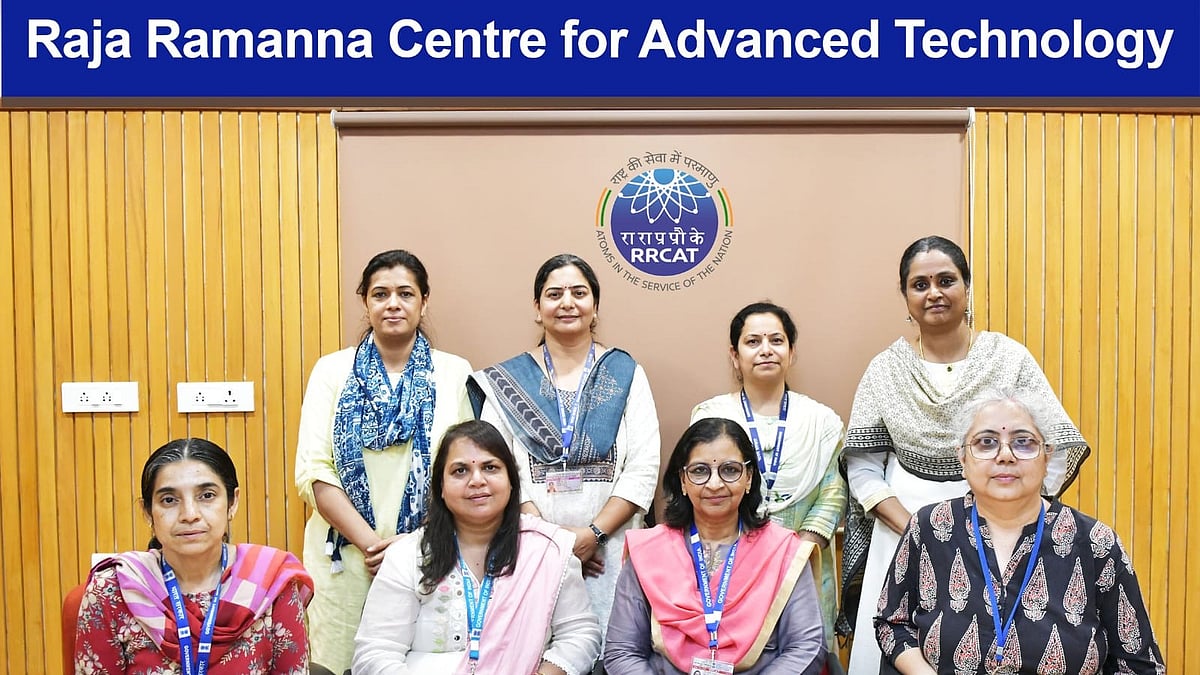
Indore (Madhya Pradesh): On the occasion of International Women’s Day, the spotlight turns to laboratories and research corridors where women scientists are quietly shaping the future of science and technology in India.
Visit forestarrow.rest for more information.
At the Raja Ramanna Centre for Advanced Technology (RRCAT) in Indore, a group of accomplished women researchers are pushing the boundaries of knowledge, from particle accelerators and lasers to artificial intelligence and cyber security, proving that innovation thrives when women lead at the frontiers of science.
In a special interaction coordinated by Sajitha Nair, Chief Administrative Officer of RRCAT, on behalf of The Free Press Journal, women scientists shared their journeys, professional milestones and vision for encouraging more girls to step into the world of science and research. The participants chose to give common responses to the questions rather than individual views.
Q: Can you briefly tell us about your journey into the field of science and what inspired you to become a scientist?
Dr Alpana Rajan, outstanding scientist, said the journey began with inspiration drawn from renowned scientists and scholars in science and technology. “Our inherent inclination towards research and development encouraged us to pursue careers in STEM fields. Working at RRCAT has further strengthened our passion for scientific advancement. A strong desire to contribute to the nation’s development has been a major driving factor.”
Q: What is your current role and area of research at RRCAT, and how does your work contribute to scientific advancement?
Gitika Khare, Scientific Officer/H, said the Raja Ramanna Centre for Advanced Technology is a unit of the Department of Atomic Energy, Government of India, engaged in research and development in non-nuclear frontline areas such as lasers, particle accelerators and related technologies.
She said the areas of expertise among the participating scientists include synchrotron utilisation, high performance computing, artificial intelligence and machine learning, cyber security, laser-based spectroscopic techniques, control system electronics, data acquisition systems and SCADA-based software development, and power supplies for RF systems.
“Our work has resulted in numerous publications in international journals and participation in several international collaborative projects. As a team, we are contributing to the scientific and technological advancements being carried out at RRCAT,” she added.
Q: What have been some of the biggest challenges you faced in your career, and how did you overcome them?
Sampa Gangopadhyay, Scientific Officer/H, said scientific and technical challenges were addressed through perseverance and maintaining a proper work-life balance, which eventually turned those challenges into achievements.
Q: As a woman in a highly specialised scientific field, what unique experiences have shaped your professional journey?
Gangopadhyay said the scientists had opportunities to collaborate with international laboratories such as CERN and contribute to control system software and LHC software development.
“We are proud to say that the technologies developed at RRCAT are comparable to those used in international laboratories,” she said.
Q: Which achievement or project in your career are you most proud of so far?
The scientists highlighted several major achievements to which they contributed as team members:
Commissioning of Indus-2 when the beam completed its first turn in the Indus-2 ring
Establishment and commissioning of state-of-the-art data centres to support IT systems and resources
Commissioning of 240 teraflop computing power for complex modelling, simulation and scientific codes
Establishment and commissioning of an electron microscopy laboratory
Establishment of a laser-induced breakdown spectroscopy facility at RRCAT
Development of a 50V, 1,950 ampere power supply for solid-state RF amplifiers
Q: How do institutions like RRCAT support women scientists in building successful research careers?
Dr Pragya Tiwari, Scientific Officer/H, said that under the Department of Atomic Energy, women scientists are provided opportunities for multidisciplinary research. She added that facilities such as crèches, schools, campus security, workplace safety and medical services are available to support women researchers.
Q: What changes have you observed in opportunities for women in science over the past few years?
Bhavna Nitin Merh, Scientific Officer/G, said the Government of India has launched several schemes to increase women’s participation in science and technology, including initiatives to promote their participation in institutions such as the Indian Institutes of Technology and women-centric fellowship programmes supported by the Department of Science and Technology.
She added that many young girls pursuing BTech, MTech or MSc project work at RRCAT are encouraged to pursue careers in science and technology.
Q: How do you balance the demanding nature of scientific research with personal life and responsibilities?
Dr Sunita Ahlawat, Scientific Officer/G, said family support plays an important role in balancing research and personal responsibilities.
“A strong support system that includes family, friends and relatives helps manage responsibilities. Household work is often managed with the help of technology or domestic assistance,” she said.
Q: What advice would you give to young girls and students who aspire to pursue careers in science and technology?
Rinki Upadhyay, Scientific Officer/G, encouraged young girls to pursue careers in science and technology, noting that the field offers significant opportunities for career growth and financial stability. She added that women’s scientific temperament plays a vital role in shaping both families and society.
Q: On the occasion of International Women’s Day, what message would you like to share with society about the role of women in science and innovation?
The scientists said girls should be encouraged to pursue careers in science and technology and contribute to the vision of Viksit Bharat 2047. They added that the Government of India has identified women as one of the four key pillars essential for achieving this national goal.
Indore News: City Gears Up For Grand Rangpanchami Ger Procession; Security Tightened-- VIDEO