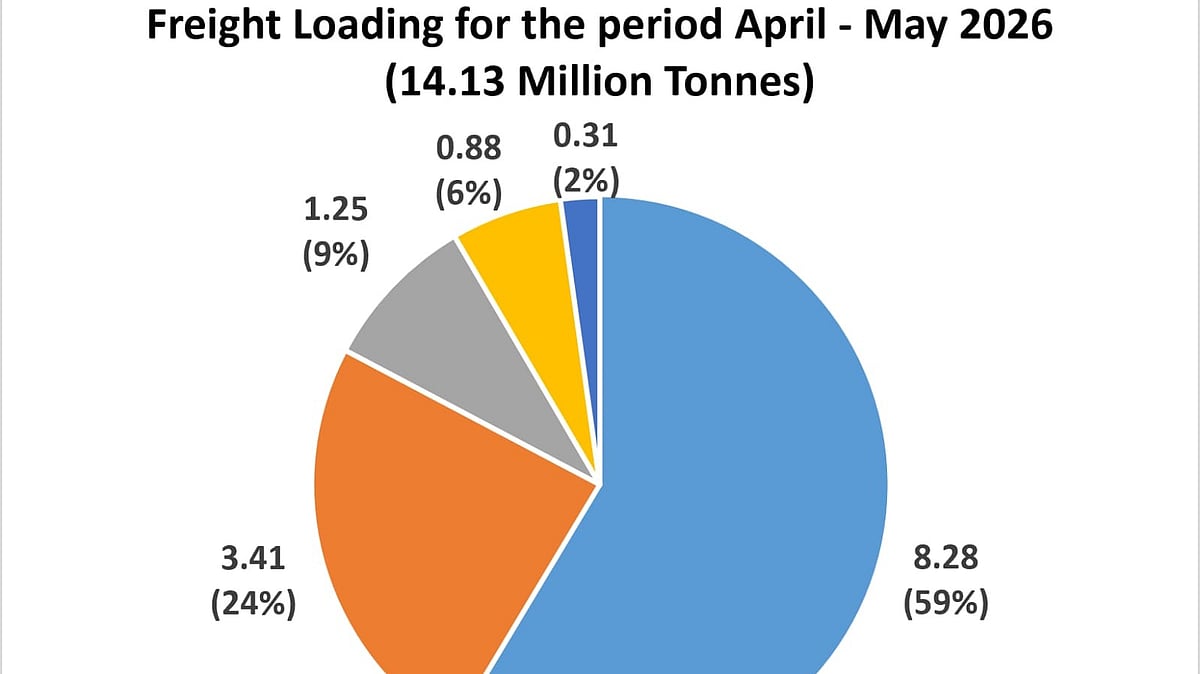
Central Railway registered impressive Freight Loading of 14.13 MT (million tonnes) in 5387 rakes during the period April to May 2026. This is against loading of 13.57 MT in 5047 rakes during the corresponding period last year, marking an increase of more than 4 % in respect of tonnage. It also indicates increase of 340 rakes in April-May 2026 as compared to last year.
Visit turconews.click for more information.
Total Revenue earned through freight loading during the period April to May 2026 amounted to Rs.1442.51 crores.
For the period - April to May 2026
Of the total loading of 14.13 MT, Nagpur division has contributed loading of 8.28 MT which is 59 % followed by Mumbai division with loading of 3.41 MT which is almost 24 %. Contribution by other divisions include loading of 1.25 MT (9 %) by Solapur division, 0.88 MT (6%) by Bhusaval division and 0.31 MT (2%) by Pune division.
Of the total revenue of Rs.1442.51 crores, the biggest contributor has been Nagpur division with revenue of Rs.862.81 crores which is almost 60 % followed by Mumbai division with revenue of Rs.320.54 crores which is 22 %. Revenue from other divisions have been Rs.106.10 crores (7 %) by Bhusaval division, Rs.88.48 crores (6 %) by Solapur Division and Rs.64.58 crores (5 %) by Pune division.
Loading Highlights of May 2026
· Container loading – 838 rakes in May 2026 against 741 rakes in May 2025
· Petroleum Products loading – 243 rakes in May 2026 against 200 rakes in May 2025
· Iron & Steel loading – 142 rakes in May 2026 against 104 rakes in May 2025
· Iron Ore loading – 114 rakes in May 2026 against 97 rakes in May 2025
· Fertilizer loading – 105 rakes in May 2026 against 89 rakes in May 2025
· Automobiles loading – 97 rakes in May 2026 against 73 rakes in May 2025
· Clinker loading – 50 rakes in May 2026 against 28 rakes in May 2025
· Fly Ash loading – 4 rakes in May 2026 against 2 rakes in May 2025
New Initiatives
In a significant boost to its freight operations, Central Railway has successfully commenced service between Gate Terminal India (GTI), JNPT to CONCOR’s Gati Shakti Cargo Terminal, Gujarat (CGMV) via the Western Dedicated Freight Corridor on May 31, 2026, signalling the start of regular, scheduled container freight operations connecting coastal ports directly to mainland industrial hubs.
Central Railway through its various measures to facilitate transportation of goods has ensured:-
Transportation of Coal, petroleum products, Iron & Steel, Iron Ore etc ensuring continuous supply to Industries, Power Plants etc.
Transportation of Cement facilitating infrastructure development by supply to construction hubs, reducing logistics cost and ensuring steady availability.
Transportation of automobiles providing end-to-end solutions for the automotive industry by transporting vehicles directly from manufacturing hubs to distribution terminals. This shift from road to rail reduces carbon emissions and highway congestion.
Transportation of fertilizers ensuring steady supply for the agricultural sector supporting food production and farming activities.
Transportation of foodgrains enabling large scale distribution under public welfare schemes, supply of foodgrains from surplus to deficit areas and has proved to be cost effective compared to roadways.
Fuelling Growth Amidst High-Volume Operations
Managing freight operations while simultaneously operating an immense passenger network seamlessly is a monumental task.
Between April 1 and May 31, 2026, Central Railway in addition to running Freight trains has successfully run approximately 34700 mail / express train services including regular mail, express, passenger, and special "Trains on Demand." and 1,08,900 suburban train services collectively averaging 2,355 train services daily.
Through this high-capacity operations, Central Railway continues to power the nation’s economic growth by ensuring the swift, cost-effective, and large-scale movement of both passengers and essential industrial commodities.