There is a growing bipartisan consensus that the state of our semiquincentennial is FUBAR.
Visit somethingsdifferent.biz for more information.
"I'm actually pretty pissed at how badly they've bungled America 250," tweeted conservative culture warrior Matt Walsh (no relation) on Saturday, in reaction to President Donald Trump's proposal to replace an increasingly musicianless Great American State Fair concert series on the National Mall with "the man who gets much larger audiences than Elvis in his prime, and he does so without a guitar, the man who loves our Country more than anyone else, and the man who some say is the Greatest President in History (THE GOAT!)."
Democrats, as is their recent wont, posted sick memes and mocked the available talent. "Trump's 250th celebration," harrumphed #NeverTrumper David Frum, "is a fiasco."
There is a natural tendency in these fallen times to harken back to the rosier-colored memories of the 1976 bicentennial celebration. The Tall Ships! The Queen (this one, not that one) in Boston! Schoolhouse Rock! I was there, in Toughskins, and it was awesome.
"On the one hand, it's truly sad that we will never be able to celebrate America's 250th the way we did the Bicentennial in 1976," National Review's Jeffrey Blehar lamented Friday. "I love this country every bit as much as I did when I was born in 1980. But this was the most foreseeable outcome imaginable."
Those of us born in 1968 or before can testify to a couple other salient facts about '76 that may yet help us salvage or at least contextualize whatever it is that we're all doing in 2026. Beginning with: The bicentennial was not greeted as an artistic or planning success in real time. Far from it.
The Tall Ships revue, majestic as it eventually was, launched with a widely mocked crash. The great cities of the Revolution—Boston, Philadelphia, New York—were in apocalyptic disarray. Much of the day-to-day bicentennial experience came not as soberly shared reflections on our creedal heritage, but rather the latchkey-kid consumption of cornball car commercials.
"The feeling persists that, amidst all the clamor and energy, a great opportunity was somehow lost," averred the New York Times art critic Hilton Kramer at the end of that celebratory year. "We seem not to have been quite equal to the occasion."
President Lyndon Johnson's original idea back in 1966 was to use the bicentennial as a showcase for the self-evident glories of…urban renewal. Philadelphia leaders countered with a possible 1976 World Fair, hoping to recapture the glory of the Centennial Exposition a century before. But "an expensive, celebratory international exposition," noted historian M.J. Rymsza-Pawlowska in The Inclusive Historian's Handbook, "was out-of-step with the troubled contemporary moment."
Then came backlash against the heavy-handed ministrations of a vulgar Republican president. Richard Nixon replaced LBJ's picks on the bipartisan American Revolution Bicentennial Commission with his own cronies and donors, prompting would-be participants to back out of what was shaping up to be a more explicitly partisan exercise. The commission would eventually come under investigation and be replaced by a congressionally authorized American Revolution Bicentennial Administration (ARBA). Then as now, Washington treasured its narcissism of small bureaucratic differences.
The early '70s being the early '70s, there was also a dog's breakfast of sociopolitical movements eager to throw turds in the national punchbowl. "A group called the Bicentennial Without Colonies sought to use the commemoration to point to the disjunction between the ideals and realities of the Revolution, specifically the ongoing inequality, disenfranchisement, and imperialism evidenced by U.S. actions in Puerto Rico," wrote Rymsza-Pawlowska. "Local and national organizers for the Black Panther Party and American Indian Movement were involved in this latter effort and in interviews, speeches, and publications, also drew attention to the federal Bicentennial's erasure of both the histories of inequality and the contributions of people of color to the nation." Sometimes the past isn't a foreign country…
By 1973, the ARBA had largely punted on any grand national gestures, opting instead to dish out grants to whatever state and local celebrations looked promising. Turns out there were lots! Parades and historical re-enactments galore, an odd and oddly moving Bicentennial Wagon Train in reverse to Valley Forge, area dads embarrassing their kids with powdered wigs and theatrical speeches. Not the kind of stuff to send thrills up the legs of New York Times art critics, but that was—maybe still is!—precisely the point.
When 2026 Gen Xers and Gen Jonesers wax nostalgic about the Bicentennial of their youth, part of the lament is for the passing of common culture. As Robert Pondiscio observed recently in Commentary, "we were…living in the last days of the three-network, Time-and-Newsweek world that functioned, for all its flaws and limitations, as a civic commons. When the Bicentennial unfolded, it did so on a shared stage."
That stage so very much included tacky commercial culture—the Coke ads, 7Up's 50 Cans for 50 States campaign, the collectible bicentennial quarters. "Much of it was kitschy, crass, and transparently designed to separate Americans from their money," Pondiscio notes. As if that's a bad thing!
Pop culture and sports, too, were spitting out spar-spangled ephemera. Yes, there were 1776 and Schoolhouse Rock, though for the latter we tend to remember the winning strains of "No More Kings" and "I'm Just a Bill" more than the problematic Manifest Destiny of "Elbow Room." But, as importantly, you couldn't turn on an AM radio without hearing Elton John's #1 pre-disco banger "Philadelphia Freedom" (fittingly, a song written by one then-closeted icon about the sports team owned by another). The then-peaking American Basketball Association featured a red, white, and blue ball to go with its gravity-defying afros; all major professional sports leagues in 1976 held their All-Star games in Philly.
And the City of Brotherly Love, despite or because of its thwarted ambitions to host a new World Fair, provided what might ultimately be the greatest synthesis of bicentennial-era culture: the Oscar-anointed Best Picture of 1976, Rocky.
I say "synthesis" advisedly. One of the main reasons tastemakers sneered at so much '76-era cultural product was that critics fretted it might just be another instance of "the New Nostalgia"—mid-'70s movies and music and TV shows that leapfrogged backward over the tumultuous 1963–'74 period in favor of the comparatively innocent rock 'n' roll '50s, or the boom/bust cycle between the two world wars, or even the settling of the western frontier. American Graffiti, Happy Days, Little House on the Prairie, and so on. The bicentennial mythology of Betsy Ross, which the aforementioned Matt Walsh recently complained was fading in cultural memory, is testament to the power of simplistic 50-year-old narratives.
But that's not all of what was happening. Give the dog's breakfast crew some credit—by front-loading counternarratives of the historically oppressed, activists and historians and artists of the era made the bicentennial infinitely richer by insisting on their own participation. Richard Pryor's (Grammy-winning!) Bicentennial Nigger in 1976 is a bracingly uncomfortable listen to this day. Alex Haley's blockbuster 1976 historical novel Roots (which James Baldwin called "his birthday present to us during this election and Bicentennial year") kickstarted a nationwide craze in genealogy. Presented with a warts-and-all depiction of American history, with all its foibles and cruelties and glories and flaws, people in this great goddamned country just said "More, please!"
Which brings us back to Rocky. Unfairly maligned in the recent Morgan Nelville documentary Breakdown: 1975 as marking the end of mid-'70s independent, socially relevant cinema, the Sylvester Stallone career-maker, set famously in Philadelphia, features one of the greatest of our fictional bicentennial characters: Apollo Creed. Patterned on Muhammad Ali, who by 1976 had graduated from controversial, norms-shattering firebrand to the object of near-universal acclaim, Creed, a business-savvy showboat, is an opponent but not quite villain, setting up a character arc in the racially complicated series that ended not only with him being martyred (by a commie!) but with his son taking over the reboot of the franchise.
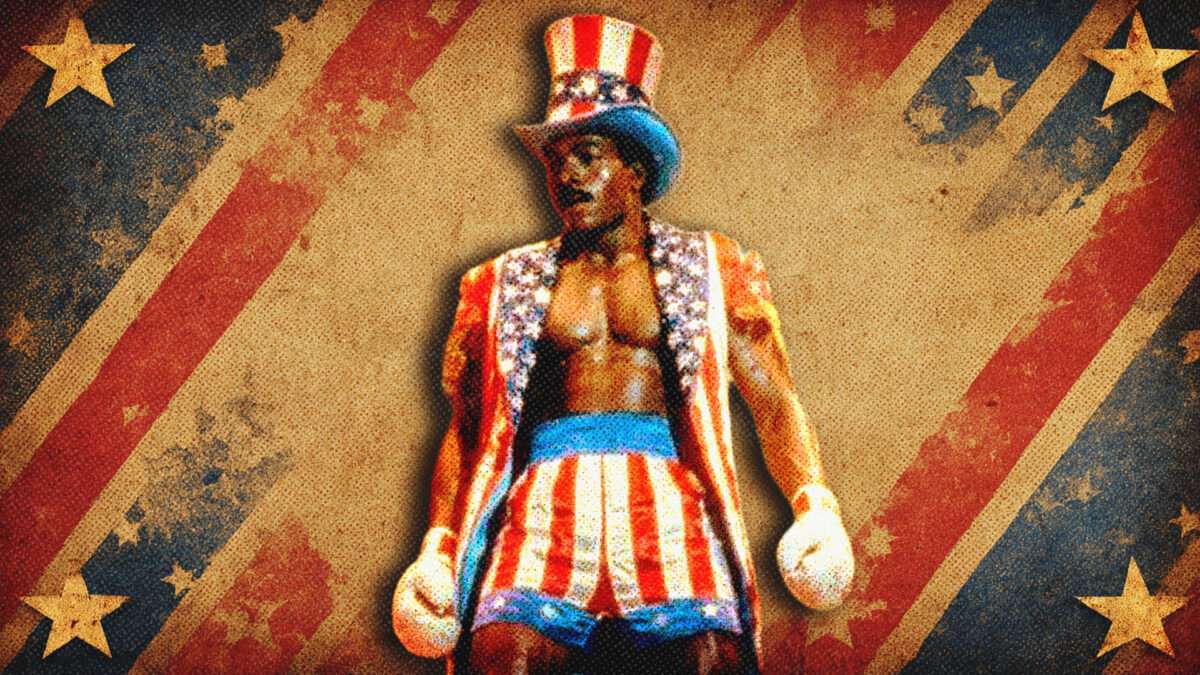
How does the Carl Weathers–portrayed boxer come out for the title fight in that first movie? Dressed as George Washington, star-spangled everything, pulled by statues of liberty, throwing coins out to the rapturous crowd in Rocky's own hometown. Brash, yes; but also? Yankee Doodle badass:
Americans loved to root for Rocky, and they loved to root for Apollo Creed. The 1976 society reflected in that film and other classics like Bad News Bears understood that we were all imperfect bastards who might well deserve to lose in the end, but (unlike, say, Peter Thiel) would stick around and fight, laughing through our bruises.
As in 1976, there is zero shortage in 2026 of local anniversary events to attend. (I've been to a dozen or so, and I cannot recommend it highly enough.) Ken Burns has that new doc, you will never run out of high-quality Revolutionary books to read, and I see in my algorithms there's a new Young Washington movie coming out just in time.
We cannot, and should not want to, replicate an era when the government constriction of choice corralled most of us into consuming the same or similar media content. But for that vast, vast majority who do not view patriotism as problematic and who love this big and wonderful and horrible country for exactly what it is, there's a bicentennial lesson just laying there: make it local, embrace the commercial, chortle through the pain, and stop giving the president of the United States even one flying fuck.
The post The Federal Government Botched the Bicentennial Too appeared first on Reason.com.