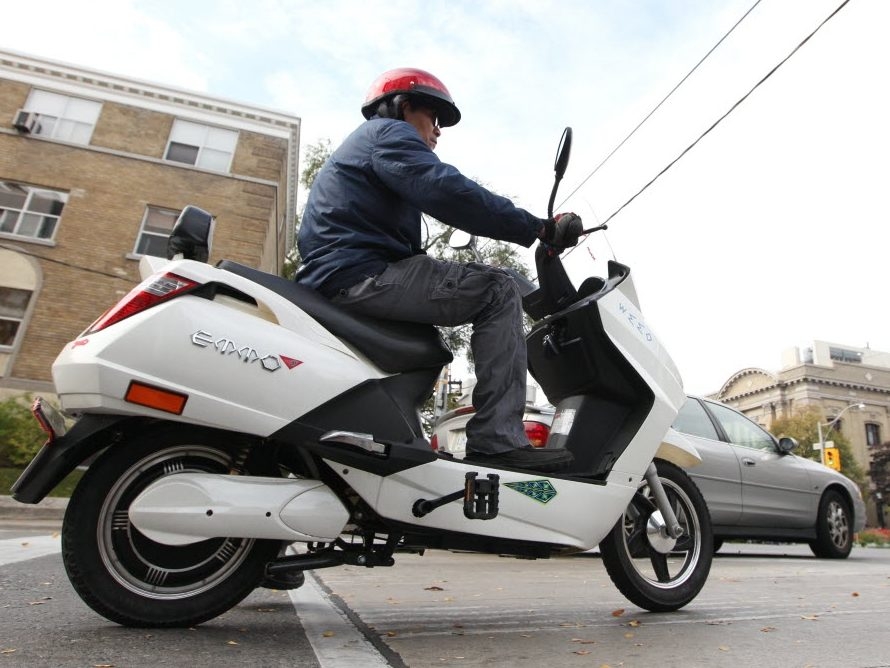
Are you sick of those miniature motorcycles increasingly seen on Toronto’s streets? So is mayoral candidate Brad Bradford.
“A pedal welded to a mini-motorcycle does not make it a bicycle. A senior on the sidewalk, a parent in the bike lane and a family in an apartment building deserve more than a city hall that has chosen wilful ignorance over leadership,” Bradford said in a campaign press release distributed Wednesday.
Visit casino-promo.biz for more information.
Bradford is proposing an eight-point crackdown as Toronto city council meets this week, with e-bikes already on the agenda.
Power-assisted bicycles, better known as e-bikes, have been evolving much faster than the rules that restrict their use, as was clear at this month’s meeting of the city’s infrastructure and environment committee.
Michael Longfield, executive director of the non-profit Cycle Toronto, gave a presentation to the city councillors on that committee. He showed four “micro-mobility vehicles” – one of which might easily be confused with a motorcycle – that today are treated the same by the provincial Ministry of Transportation.
While the province is moving to better categorize e-bikes, the City of Toronto has already brought in bylaws to restrict their use. “This is a very well intended, but it’s also an extremely confusing, state right now,” Longfield told the committee.
“We’re trying to define where these various things can go. Many of them are legal to buy. They’re not legal to use on public roads. They’re able to be used on some types of cycling infrastructure, not all. It’s not often very clear to look at them what kind they are or aren’t.”
At the meeting, Dianne Saxe, the councillor for University-Rosedale, said she had brought forward the motion on e-bikes at Longfield’s request.
That motion was sent forward to this week’s city council meeting. It directs city bureaucrats to work with the province and asks Queen’s Park to essentially exclude faster, heavier machines from its e-bike framework, treating them like proper motorcycles.
That would include things like requiring riders to be licensed and insured.
“While council will deliberate on an open provincial consultation this week and has asked city staff to return with bylaw amendments by January 2027, Torontonians deserve a council and a mayor who take action now,” Bradford’s statement says.
Fires, infractions
His eight-point plan includes an “appearance-based exclusion” he says is modelled on Quebec’s rules “that disqualifies motorcycle and moped-styled devices regardless of label, based on visible features such as footrests, body panels, non-adjustable saddles and motorcycle-style wheels.”
Other proposals include fast-tracking the proposed changes and working with local couriers and retailers to get riders to obey the rules of the road.
Two of his points also call for better battery safety standards. E-bike batteries have increasingly been blamed for fires, such as a blaze at a west-end apartment building late last year.
“Under Mayor (Olivia) Chow, we have been asked to accept that motorcycles on the sidewalk and battery fires in our buildings are just the price of a growing city. They are not,” Bradford said, per the statement. “Innovation does not have to come at the cost of public safety.”
Bradford, the councillor for Beaches-East York ward, is perceived as the front-runner in this fall’s mayoral race. Chow has yet to register for re-election.
As e-bikes have become a fact of life in Toronto, so too has irritation with how some riders operate them. Last fall, officers laid 179 tickets in a micro-mobility vehicle enforcement blitz in the city.
Councillors are aware that while e-bikes have become more popular, not everyone is a fan.
“One of the most frustrating things when we were working through our micro-mobility strategy last year was the reality that so many of these vehicles are currently on our streets, they’re creating conflict, there’s a lot of open questions about them,” Councillor Amber Morley said during the infrastructure and environment committee meeting.