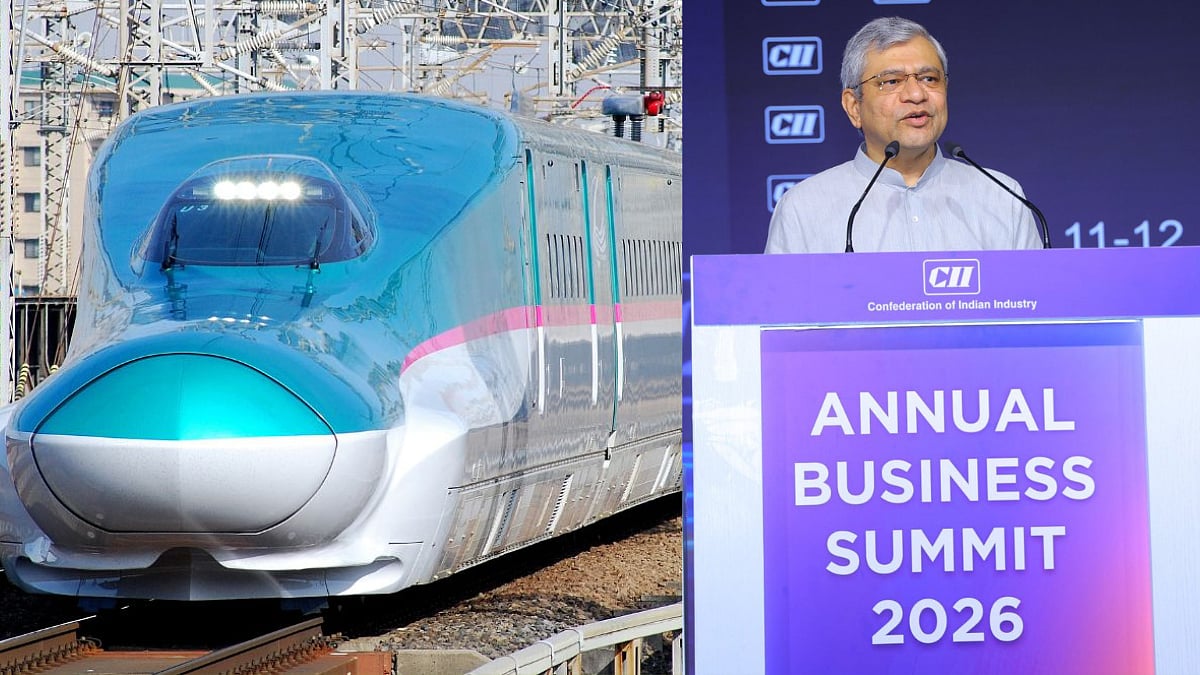
India’s high-speed rail network expansion may pressure aviation companies on some of the country’s busiest routes, warned Railways Minister Ashwini Vaishnaw on Monday.
He said that investors betting on the growth of the aviation sector through routes such as Mumbai-Pune, Hyderabad-Bengaluru, and Bengaluru-Chennai should look at the changes in travel behaviour in Japan, China, and South Korea after the introduction of high-speed rail in these countries.
Visit rouesnews.click for more information.
The minister argued that high-speed rail networks in these countries led passengers to shift to the new travel option instead of continuing to commute by flights.
“The new high-speed railway corridors will lead our large state economies to become one single economy. This transformation will ripple across Western, Southern, and Northern India, creating a unified economic landscape.” -Shri Ashwini Vaishnaw, Hon’ble Minister for Railways,…
— Confederation of Indian Industry (@FollowCII) May 11, 2026
“See the change that will happen because of these high-speed rail corridors in the country. Take the Mumbai-Ahmedabad corridor. These two cities — and the cities in between, like Surat, Vapi, Vadodara, and Thane — will all become one city, one economy, and one region because Mumbai to Ahmedabad will take 1 hour and 57 minutes,” he said.
Mumbai–Ahmedabad Bullet Train Project Update: Massive Engineering Feat Achieved As Portal Beams Successfully Installed Near Maninagar“Nobody will fly (on these routes). These sectors will be out for airlines. I am reminding those who want to invest in airlines. About 99 percent of these routes will be dominated by railways,” Vaishnaw said.
He highlighted that in the last few years, capital expenditure on railways has increased from Rs 66,000 crore to about Rs 2.72 lakh crore in FY26. He said the capacity of the Railways Department and the overall sector has also grown at the same pace to execute large-scale infrastructure projects. Vaishnaw was speaking at the CII Annual Business Summit 2026 on Monday in New Delhi.
“India’s railway infrastructure is transforming at an unprecedented scale. With a significant surge in wagon and locomotive production, our capacity to spend and execute CAPEX has reached a new frontier.” Shri Ashwini Vaishnaw, Hon’ble Minister for Railways, I&B, and MeitY, GoI… pic.twitter.com/jKPGNfklMi
— Confederation of Indian Industry (@FollowCII) May 11, 2026
During the last decade, the government added 36,000 kilometres of rail tracks, while 49,000 kilometres of tracks were electrified.
Vaishnaw also praised the pace at which the Dedicated Freight Corridor was completed. Due to the freight corridor, the time taken to transport goods from hinterlands to ports has reduced from 48-50 hours earlier to 12-16 hours now.