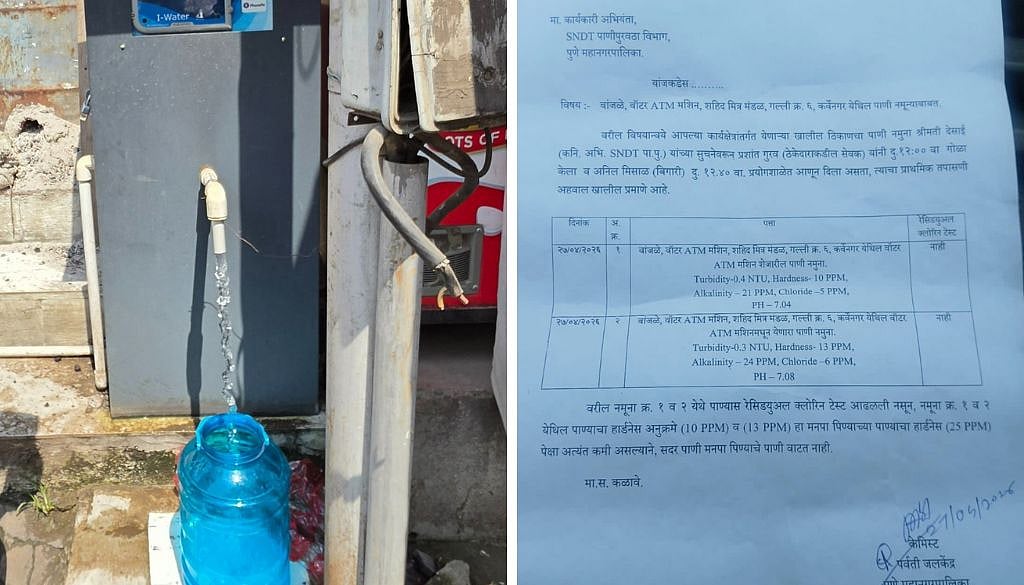
A disturbing issue has emerged in Pune’s Karvenagar, where water being dispensed through a local “Water ATM” has reportedly been found unfit for drinking. The issue has surfaced at the Wanjale Water ATM located in Lane No. 6, Shaheed Mitra Mandal area in Karvenagar.
The machine supplies water at the rate of ₹1 per litre and ₹5 for 10 litres and is widely used by students, as Karvenagar is known as a major student hub. Hundreds of students reportedly depend on the facility daily, attracted by the promise of affordable purified drinking water.
Visit casino-promo.biz for more information.
However, following doubts raised about the quality of water being dispensed, a complaint was submitted to the Pune Municipal Corporation’s Water Supply Department. Acting on the complaint, Junior Engineer Aparna Desai ordered the immediate collection and testing of water samples.
‘If Not Mine, Then No One’s’: Pune Woman Stalked & Threatened For MonthsOn April 27, water samples collected from the machine were sent for laboratory analysis. The findings, according to the municipal report, are alarming.
Both samples reportedly showed zero residual chlorine, a key indicator necessary to prevent microbial contamination in drinking water. The absence of chlorine raises concerns over possible bacterial presence.
The report also revealed that while PMC’s regular drinking water generally has a hardness level of around 25 PPM, the water from the ATM showed hardness levels between 10 and 13 PPM, significantly lower than expected.
Pune: Black Magic Angle In Ajit Pawar's Death? MLA Rohit Pawar Links Ex-DCM's Demise To Ashok KharatAccording to the preliminary findings, the water does not appear to be sourced from the municipal supply network and may be coming from a borewell or another unauthorised source.
“It does not resemble municipal drinking water, and the absence of chlorine could make it hazardous to public health,” the laboratory’s preliminary observations reportedly stated.
BJP leader Sandeep Khardekar has demanded accountability, questioning who would be responsible if contaminated water leads to illness or an outbreak among students.