One of the best films of the year so far wasn’t made by a brash young director, and it doesn’t come with a costly advertising campaign. Steven Soderbergh was the hot young director of 1989, the year his debut, Sex, Lies, and Videotape, won the Palme d’Or at Cannes. And he’s been hot on and off since, either at the helm of well-made mainstream hits like 2000’s Erin Brockovich, or riding the crest of the Ocean’s franchise. Now he makes intelligent, entertaining movies—sometimes more than one per year—that tend to get lost both in the firehose of stuff blasted at us from the big streamers and the more boutiquey, ostensibly adventurous independent releases aimed at younger audiences. Many of us often find ourselves asking, Where are the smart, entertaining movies made for grownups? Soderbergh is one of the few directors making them, and the latest of these isThe Christophers, which is both modest and extraordinary.
The setting is modern-day London. Lori Butler (Michaela Coel), an art restoration expert who also happens to be an accomplished forger, gets a request from an old art school classmate, Sallie (Jessica Gunning, of Baby Reindeer), and her brother, Barnaby (James Corden), the money-grubbing offspring of a legendary painter who hasn’t produced a new canvas in years. He’s best known for several series of paintings known somewhat mysteriously as The Christophers, which have fetched millions at auction. Apparently, there’s an additional, unfinished Christophers series lurking in storage in one of the artist's two side-by-side London townhouses. Sallie and Barnaby want Lori to ingratiate herself into their father’s home and complete the paintings in his style. They suspect their father is going to kick the bucket any minute, and they’re desperate to secure at least some kind of inheritance.
Visit extonnews.click for more information.
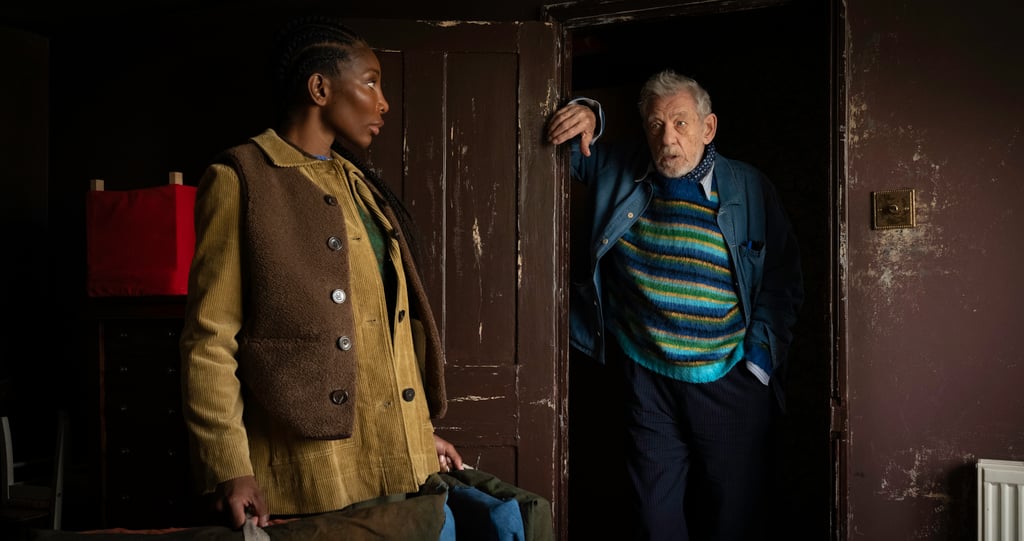
McKellen as Julian —Claudette BariusAnd so Lori, having presented herself as a potential assistant, infiltrates the fortress of Julian Sklar (Ian McKellen), a cantankerous eccentric decked out in a series of fantastic, knobbly old Shetland sweaters, aristocratically rumpled overshirts, and jaunty neckscarves—he even favors that most clichéd bit of artist-wear the beret, though it all looks perfectly natural on him. Julian’s digs are a glorious, sprawling, intriguing mess, a little like he is. One room might feature a saggy antique couch dotted with slouchy Victorian pillows, another an assemblage of sleek space-age Italian furniture. Groups of disparate pictures are arranged in what influencers have come to call a “gallery wall,” though it’s really just how nearly everyone used to hang stuff. There’s a stuffed ostrich here, a shelf full of empty jars and bottles there, all brushed with whispery, burnished light. (The film, shot by Soderbergh himself under one of his usual pseudonyms, looks fantastic.) The walls of one room are dotted with splashes of paint, as is the door—it tells a story by itself, apparently having been pushed open a million times with painty fingers.
But Julian hasn’t painted in years. He makes money by recording crotchety Cameo videos—a feature of his standard template appears to include urging aspiring artists to just give up. He’s intensely focused, a little dotty, and very mean. Lori cagily tries to flatter him; he does all he can to make her go away, though he admits he’s susceptible to flattery. “I just need to believe it,” he purrs. Somehow he gives her permission to return the next day. In the interim, he finds out more about her and what she really thinks of him, though that only seems to make him respect her more. Meanwhile, she locates the unfinished Christophers canvases—they’re stashed in a bathtub in one of the house's 1,001 cluttered rooms—and gets to work, though it's not long before she decides to shift the course of her deception altogether.
The Christophers is a wily little movie. It’s not trying to be about anything, which means it somehow ends up being about lots of things. It’s about punctured pride, about the rarity of finding people who can call us on our baloney, about the meaninglessness of art that means nothing and the eternal value of art that speaks for itself, even in mysterious or muted ways. It’s about pettiness as one of the worst human traits, and generosity, even the grudging kind, among the best. The script is by Ed Solomon, not just a co-creator of the genius Bill & Ted movies, but also the screenwriter behind clever, enjoyable pictures like Men in Black and Charlie’s Angels. The pleasures of The Christophers involve following the cagey cat-and-mouse game Julian and Lori are playing, only to see it transform into an uneasy yet unbreakable union. In one scene, Julian tries, disingenuously, to dismiss one of his own works as meaningless, and Lori shocks him by articulating exactly how he has brought technique, form, and emotion together into an indefinably remarkable something. It’s a dazzling, high-wire monologue, and Coel delivers it as if she were riding a zephyr. She’s wonderful to watch—her cautious, skeptical eyes somehow tell us most of Lori’s story before it’s revealed to us in actual words. And she keeps up with McKellen without ever losing stride.
Coel as Lori —Claudette BariusMcKellen is always good, and often great, but there’s something offhandedly magical about his performance here. Julian has a stockpile of peevish bons mots: “I was bisexual when it cost something to say it,” he informs Lori, in that lecturey way older people often try to diminish the experiences of the young. Yet he’s also joyously louche, having long ago entered his DGAF era. Greeting Lori at the door on her second visit, he descends a staircase in nothing but a loose robe and floppy pajama pants. “Do you mind me in my dressing gown?” he asks with exaggerated politeness, as the scrap of faded paisley he’s wearing flaps open to reveal an octogenarian’s naked chest. Lori makes it clear that she absolutely does mind; he then throws a trench coat over the whole ensemble, which makes it look even more lewd.
The movie is full of little jokes like this one. But at a certain point, we learn exactly who and what a Christopher is: not just a painting, but a person, someone who meant a great deal to Julian, and who hurt him very badly. He’s tried to bury his love along with the paintings. McKellen tells the story of Julian's life without overtly telling it; all the clues to his suffering are there in his eyes. And when we finally see him paint—even though we don’t see the work in progress—the fierceness of his gaze tells us all we need to know about his drive, his devotion to his work, and his sorrow.
The Christophers is largely a comedy, but it’s also about all that we gain and lose with age, and about how we sometimes need young people to bring us back to ourselves. Simultaneously meticulous and casual, it’s the kind of movie only a master filmmaker could have made—though it's doubtful Soderbergh, perpetually moving away from one movie and toward the next, thinks of himself as a master filmmaker at all. Last year alone, he gave us two terrific pictures, the understated spy caper Black Bag and the chilly, affecting ghost story Presence. He's like a jewel thief in reverse, dropping off the gems and then vanishing into the night, on to the next rooftop. This is how you make the kinds of movies people didn't know they wanted, which are maybe the only movies worth making at all.