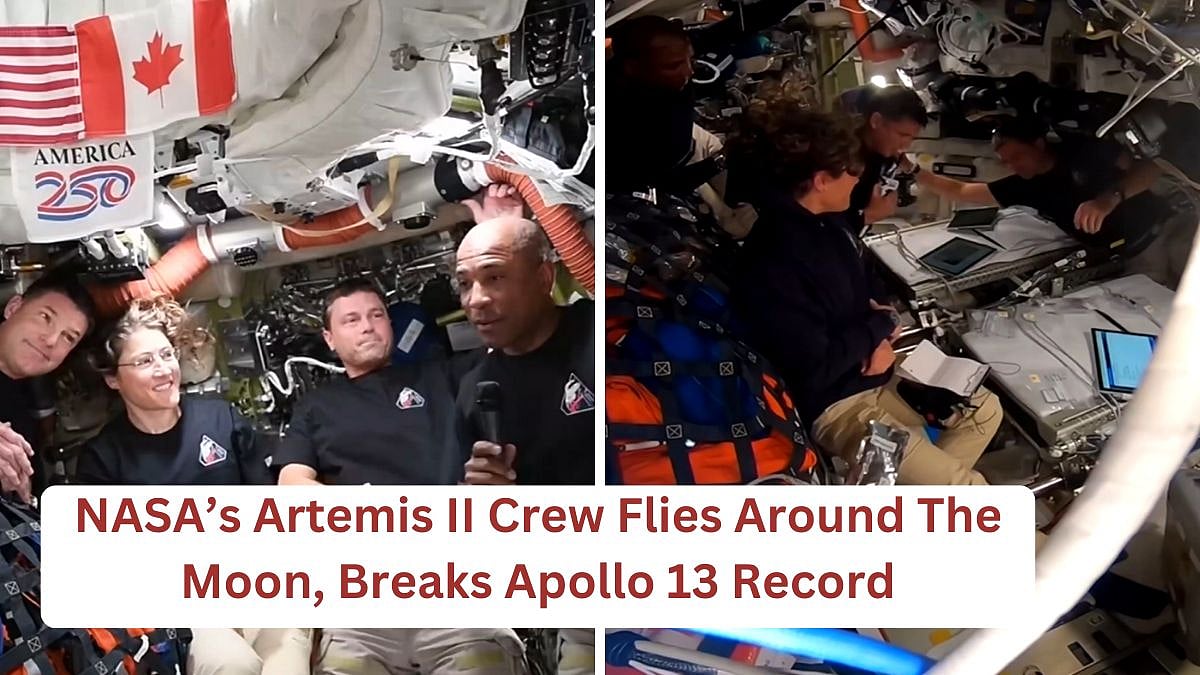
Washington: Four astronauts aboard Artemis II have scripted history by travelling farther from Earth than any humans before, surpassing the record set during the Apollo 13 mission.
Artemis II Astronauts Reach Farthest Ever From Earth
Visit esporist.org for more information.
According to NASA, the crew reached a maximum distance of approximately 252,756 miles from Earth while flying around the far side of the Moon. NASA Administrator Jared Isaacman confirmed the milestone, congratulating the astronauts and mission team.
A new milestone for humankind: The crew of Artemis II are now the farthest any human has ever travelled, reaching a maximum distance of 252,752 miles from Earth.
— NASA (@NASA) April 6, 2026
This surpasses the previous record set by Apollo 13 in 1970 by about 4,102 miles. pic.twitter.com/DbLFvvdEfT
On the shoulders of giants...
— NASA (@NASA) April 7, 2026
The Artemis II crew aboard Integrity have officially traveled farther into space than any humans before, passing the record set during Apollo. Our live coverage continues:https://t.co/do2p0Gvxdu
“On the far side of the Moon, 252,756 miles away, Reid, Victor, Christina, and Jeremy have now traveled farther from Earth than any humans in history and now begin their journey home,” he said.
NASA Shares First Stunning Earth Views From Artemis II Crew En Route To MoonArtemis II Crew Faced Temporary Communication Blackout
The crew, Reid Wiseman, Victor Glover, Christina Koch and Jeremy Hansen, experienced a temporary communication blackout of around 40 minutes as their Orion capsule passed behind the Moon.
Artemis II has reached its maximum distance from Earth.
— NASA Administrator Jared Isaacman (@NASAAdmin) April 6, 2026
On the far side of the Moon, 252,756 miles away, Reid, Victor, Christina, and Jeremy have now traveled farther from Earth than any humans in history and now begin their journey home. Before they left, they said they hoped…
During this period, the Sun was completely eclipsed from their perspective, allowing them to study the solar corona while observing the Moon’s far side. Scientists at NASA’s Johnson Space Center monitored the mission closely as astronauts shared real-time observations.
The crew also received a pre-recorded message from late astronaut Jim Lovell, who had flown on Apollo 8 and Apollo 13. “Welcome to my old neighborhood… don’t forget to enjoy the view,” he said.
— NASA (@NASA) April 7, 2026
Right now, the Orion capsule is passing behind the Moon, so the Sun is entirely eclipsed from their perspective. During this time, they will view a mostly darkened Moon and will use the opportunity to analyze the solar corona. pic.twitter.com/PWDPfZKxGh
As the Orion spacecraft travelled roughly 4,000 miles above the lunar surface, astronauts described stunning visuals. “The terminator right now is just fantastic,” said Glover, referring to the boundary between the Moon’s night and day.
Artemis-II Launch Captured By Passenger On Commercial Airline Flight Shows Rocket Thundering Towards Moon; Stunning Video Goes ViralFollowing the flyby, communication was restored, with Koch saying, “It is so great to hear from Earth again… we will always choose Earth.”
The mission marks a major milestone in deep space exploration and reinforces NASA’s push towards future lunar missions and beyond.