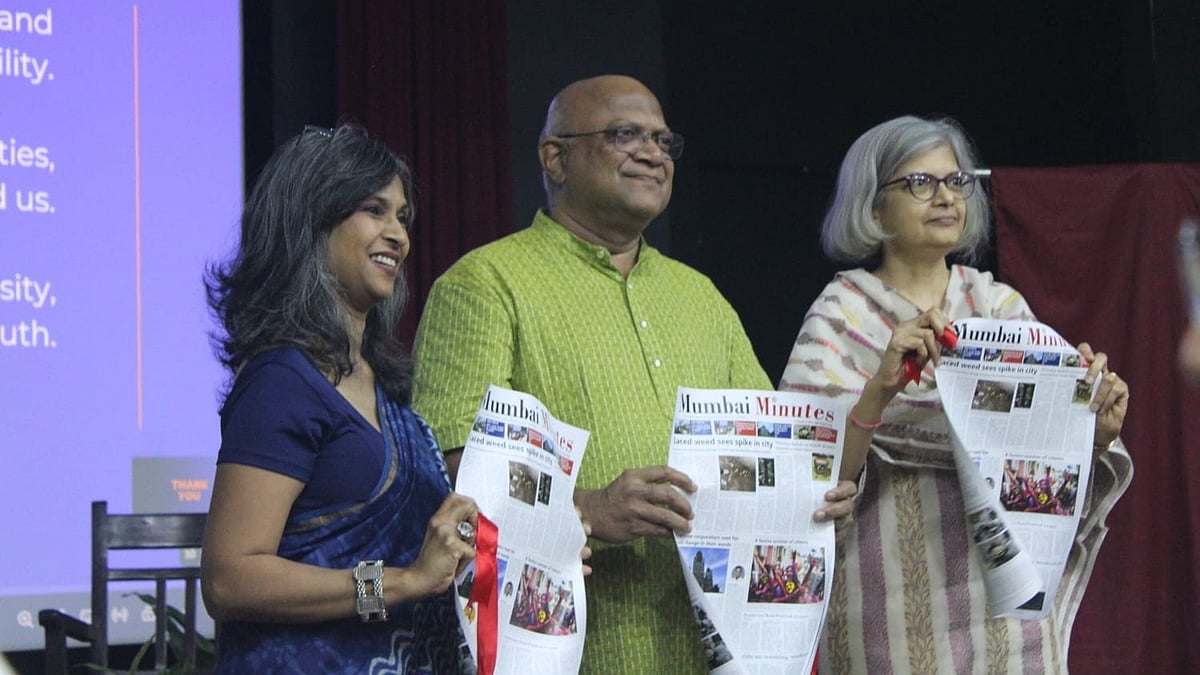
Mumbai: At Xavier Institute of Communications a group of 25 journalism students has quietly done something many newsrooms would recognise as no small feat they have put together a broadsheet from scratch. Titled Mumbai Minutes, the student-led publication is the result of weeks of reporting, editing, and collaboration under the Visiting facult and senior journalist Seema Kamdar.
Visit newssport.cv for more information.
What makes this effort stand out is its intent. Instead of routine assignments or recycled topics, the students were pushed to think like reporters in a real newsroom. “This year, I told them we are going to do hardcore news reporting and build a proper broadsheet,” Kamdar said, explaining the shift from earlier formats where students filed individual stories for tabloids.
The brief was clear which is to find stories that haven’t already been told. Each student was asked to pitch two original ideas, stories that were relevant, underreported, and rooted in the city. After rounds of discussion and refinement, one idea per student was approved. From there, the process mirrored a professional newsroom like stepping out into the field, speaking to sources, and developing the story.
For Shambhavi Dixit, a student of Journalism and Media Convergence, the experience went beyond classroom learning. “It was a great experience as I learned many new things like designing and reporting and writing the story as fast as I can. It gave us a feeling of having a byline in a newspaper,” she said, adding that the process taught her the importance of in-depth reporting. “It’s not only writing but going deeper into the story is where the real work lies.”
A newsroom simulation in real time
The project is part of a long-running newsroom workshop at the college. Sandra Vaz, Head of Journalism and Media Convergence diploma course, explained that the broadsheet is designed as a culmination of the students’ year-long training.
“We’ve been running this newsroom workshop for four to five years. It comes at the end of the academic year after students have understood reporting, writing, fact-checking, editing and design. This is where all that learning comes together into a product they can actually produce,” she said.
According to Vaz, students handle every stage of the process like from pitching ideas and researching stories to editing and deciding page placement. “They learn what goes into gatekeeping, what makes a story front-page worthy, and how important it is to get facts right. It’s all live, based on what is happening on the ground,” she added.
The result is a tightly curated publication that covers the city across beats like sports, business, and civic issues. The front page reflects the project’s ambition from stories on “matcha raves” reshaping nightlife to reports on the misuse of Nirmalya Kalash at city beaches. Another piece looks at Mumbai hosting a global pickleball league with little public attention.
Learning beyond the classroom
For many students, the assignment meant navigating real-world challenges. Ishita Shah, a postgraduate student, reported on the struggles of visually impaired commuters during peak hours. “The biggest challenge was communicating with officials and getting responses from them,” she said, pointing to the difficulties young reporters face in the field.
The process itself was immersive. Students spent multiple sessions building the publication step by step, including peer-editing each other’s work. They also decided the name Mumbai Minutes through a class vote and worked on the masthead, layout, and design using InDesign.
While the final production was guided by faculty, the editorial decisions remained largely studentdriven. Vaz emphasised that this hands-on approach is central to the department’s teaching style. “Our training is very experiential. Students don’t just learn theory they apply it through the work they produce,” she said.
In a media landscape driven by speed and algorithms, the project brings the focus back to reporting, verification, and storytelling. For these students, Mumbai Minutes is more than an academic exercise it is their first real step into the newsroom.